
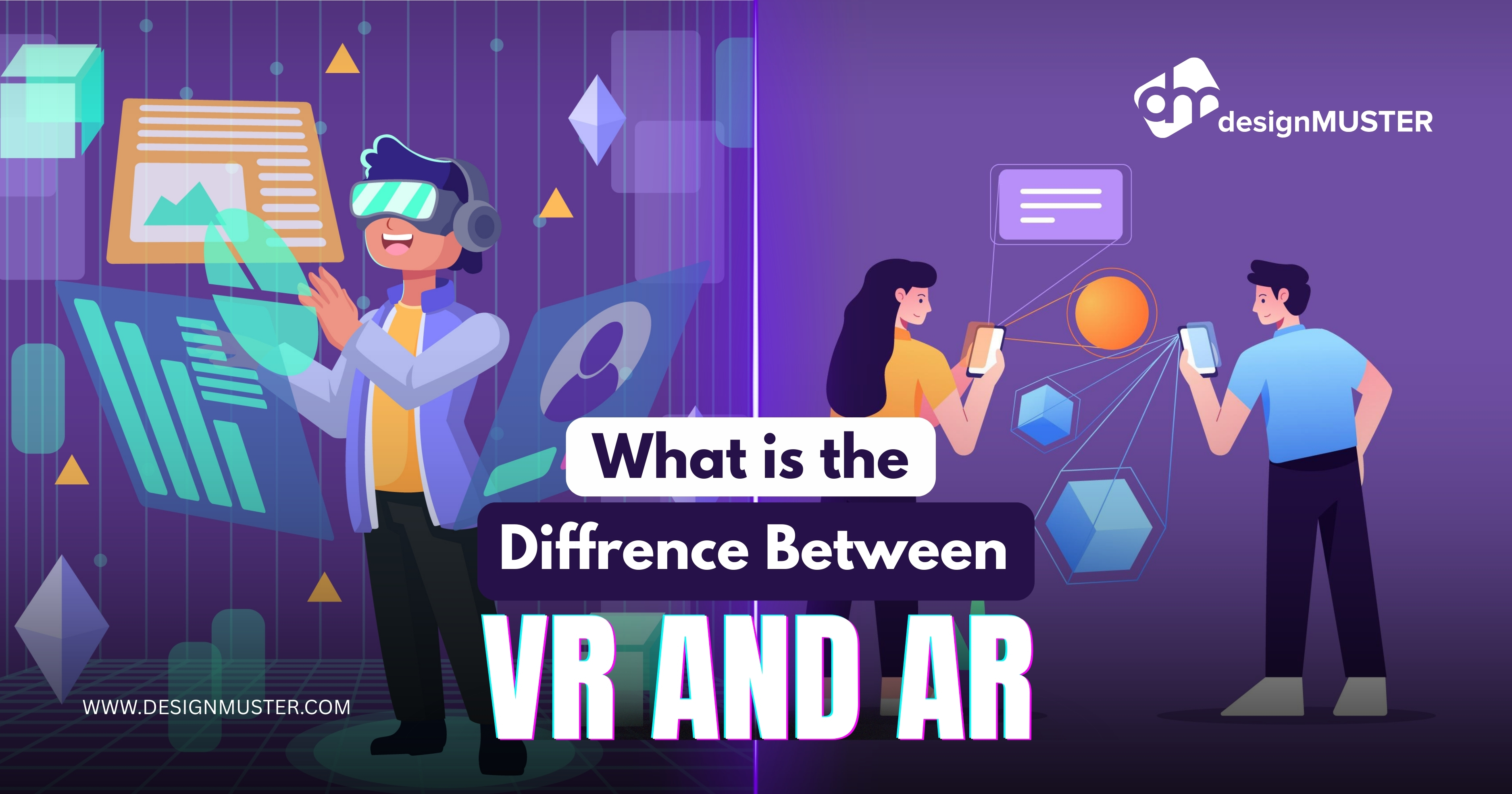
In the fast-paced world of technology, two terms are often mentioned together: AR (Augmented Reality) and VR (Virtual Reality). Both technologies are revolutionizing industries—from gaming and entertainment to education, healthcare, retail, and real estate.
But despite their growing popularity, many people are still unsure about the exact difference between AR and VR. While both involve immersive digital experiences, they are not the same.
In this blog, we’ll dive deep into what AR and VR are, how they differ, where they’re used, their benefits, and which one is right for your business.
What is AR (Augmented Reality)?
Augmented Reality (AR) overlays digital elements—like images, sounds, or information—onto the real world. Instead of replacing reality, AR enhances it.
Everyday Examples of AR:
- Snapchat & Instagram filters that add masks or effects to faces.
- IKEA Place app that lets you preview furniture in your home.
- Pokémon GO game where characters appear in real environments.
- Google Lens that identifies objects in real-time.
Key Features of AR:
- Works on smartphones, tablets, and AR glasses.
- Adds layers of information to the real environment.
- Ideal for product visualization, education, and marketing.
What is VR (Virtual Reality)?
Virtual Reality (VR) immerses users in a completely digital environment, shutting out the real world. It requires VR headsets (like Oculus Rift, HTC Vive, or PlayStation VR) that transport users into a fully simulated 3D space.
Everyday Examples of VR:
- VR gaming—exploring virtual worlds and environments.
- Virtual travel—visit tourist attractions without leaving home.
- Real estate VR tours—walk through a property digitally.
- Medical VR training for doctors and surgeons.
Key Features of VR:
- Requires a headset or special equipment.
- Fully immersive—blocks out the real world.
- Ideal for training, simulations, and entertainment.
Main Differences Between AR and VR
| Aspect | Augmented Reality (AR) | Virtual Reality (VR) |
|---|---|---|
| Definition | Enhances reality with digital overlays | Creates a completely digital environment |
| Equipment | Smartphones, tablets, AR glasses | VR headsets, controllers, gloves |
| Immersion | Partial—real world + digital layers | Full—only digital world |
| Use Case | Product demos, navigation, retail, education | Gaming, training, tourism, simulations |
| Accessibility | High—works on most phones | Medium—requires dedicated hardware |
| Interaction | Real world + digital blending | Virtual-only interactions |
AR vs VR: Which is Better for Your Business?
Use AR If…
- You want customers to interact with products in real environments.
- You’re in retail, real estate, or marketing.
- You want low-cost, accessible solutions (AR can run on smartphones).
👉 Example: A fashion brand uses AR mirrors so customers can “try on” clothes virtually in-store.
Use VR If…
- You want to create completely immersive experiences.
- You’re in gaming, healthcare, education, or training.
- You can invest in specialized VR hardware.
👉 Example: A medical school uses VR to let students practice surgery in a safe, controlled environment.
Benefits of AR in Marketing & Business
1. Product Visualization
Customers can preview furniture, clothing, or makeup before buying.
2. Interactive Advertising
Brands use AR billboards and filters to attract attention.
3. Customer Engagement
AR apps keep customers engaged longer than static content.
4. Cost Savings
No need for large product inventories—AR can showcase multiple variations digitally.
Benefits of VR in Marketing & Business
1. Immersive Storytelling
VR lets brands create memorable experiences—like taking customers on a journey through their brand’s story.
2. Virtual Training
Used in industries like aviation, healthcare, and manufacturing to train staff safely.
3. Real Estate & Travel
VR tours let customers explore properties or destinations without physical travel.
4. Enhanced Learning
VR classrooms help students learn through simulations and interactive lessons.
Future of AR and VR
Both AR and VR are part of a larger trend called XR (Extended Reality). With advancements in AI, 5G, and hardware, AR and VR will become even more accessible and impactful.
- AR is expected to dominate retail and marketing because of its accessibility on smartphones.
- VR will grow in training, gaming, and education where full immersion is essential.
By 2030, experts predict AR and VR will be a trillion-dollar industry globally. Businesses that adopt these technologies early will gain a massive competitive advantage.
FAQs:
1. Which is more affordable—AR or VR?
AR is generally cheaper since it works on smartphones. VR requires headsets, making it more expensive.
2. Do AR and VR require the internet?
Not always. Some AR/VR experiences can be preloaded, but most advanced applications need internet connectivity.
H4: 3. Can AR and VR be combined?
Yes! That’s called Mixed Reality (MR), where digital and real objects interact seamlessly.
4. Is AR or VR better for education?
Both are useful: AR enhances real-world lessons, while VR provides immersive simulations.
5. Can small businesses use AR/VR?
Absolutely! AR filters, product previews, and virtual tours are affordable and highly effective even for small businesses.
Conclusion
While AR (Augmented Reality) enhances the real world with digital elements, VR (Virtual Reality) immerses users in an entirely digital space. Both have unique applications and benefits across industries.
For businesses, AR is best for marketing, retail, and product visualization, while VR excels in training, entertainment, and simulations. Together, they are shaping the future of digital interaction.
Want to harness the power of AR & VR for your business?
At Design Muster, we provide cutting-edge AR and VR solutions that help brands engage customers, showcase products, and drive ROI.
👉 [Book Your AR & VR Service Today with Design Muster] and take your business into the future of digital experiences!